Saturday, January 28, 2006

Aghios Nikolaos II


OK, I promised a while ago that I'd try to get more pictures of the church of St. Nicholas in Mystras up. Here we go.

The pictures that follow are from the sequence that includes the prison scene, which you saw in my earlier posting. They consist of four panels from left to right, with the prison scene being the third one.

The first panel (to the right) shows three men in a bed and a king kneeling in a supplicant position before a saint.


The next panel shows the saint surrounded by soldiers


The third panel is the prison scene.


And, finally, the fourth panel. A bed again.


I know this is a scene from hagiography but I still have no idea what the paintings are about or, for that matter, in what context they were created.

Mystras has seven other major churches and twenty or so "chapels." The major churches are well described in the guidebook and elsewhere but St. Nicholas/Aghios Nikolaos is not for some unknown reason. Hence my curiosity.

Monday, January 16, 2006

Review of Marriott, The Plague Race

Edward Marriott, The Plague Race: A Story of Fear, Science and Heroism. Picador: Basingstoke, 2002

The Plague Race is a short and very readable account of the 1894 race between the French microbiologist Alexandre Yersin and his Japanese colleague and competitor Shibasaburo Kitasato to discover the organism responsible for the bubonic plague.

In the summer of 1894, Hong Kong was in the grips of the third worldwide epidemic (or pandemic) of the bubonic plague, which was devastating the island's notorious slum quarter. The local health authorities were unable to cope with the rising death toll and the colonial government issued a call for help. Two of the finest microbiologists of the day responded: Shibasaburo Kitasato arrived on 12 July and Alexandre Yersin a few days later on 15 July.

Yersin rose from a humble background in Switzerland to a promising career at the Pasteur Institute in France. But suddenly he dropped out and left for the French colony of Indochina. When the call reached him, he was active as an explorer and a microbiologist in Vietnam.

Kitasato was born in 1852 on Japan's southern island of Kyushu. He distinguished himself first as a dedicated student and then a scientist. He was chosen to study under the brilliant microbiologist Robert Koch in Berlin, where he discovered the organism responsible for tetanus. After 6 years in Germany, he returned to Japan in 1892.

From there a tale of a battle on a far from even playing field unfolds. Kitasato arrived in Hong Kong with a team of specialists and a large cargo of equipment, was received with all honours by James Lowson, the Superintendant of the Chief General Hospital and a member of the colonial elite. Lowson provided Kitasato with work space in the hospital and access to bodies for sampling and autopsies (though this had to be kept secret because of Chinese religious concerns). The professor was quartered in a comfortable hotel.

By contrast, Yersin only had two servants in his company and a mere suitcase full of equipment. He was virtually ignored by Lowson and eventually decided to build a grass hut that served as his home and research facility. To obtain specimens, he bribed the British sailors who carried and guarded the bodies. Kitasato and Yersin met briefly but once. They did not hit it off and then worked separately from each other.

Yersin quickly becomes the underdog in Marriott's narrative and one cannot help but root for him. Marriott skews the perspective early in the book by introducing the somewhat ambivalent character of Lowson, a gifted man in his own right but aslo given to colonial snobbery. To the extent that this tale can have a villain, Lowson fits the bill. Kitasato's official stature and appearance suited Lowson's taste, the loner Yersin obviously did not. From there, the tale moves towards Yersin's triumph as the discoverer of the plague. His acclamation was only delayed by Kitasato's posturing and Lowson's connivance.

The main story of the book is interspersed with a fictional account of the 1994 plague epidemic in Surat, India, current WHO plague control efforts in Madagascar (presently the country with the highest plague mortality in the world), the arrival of the plague in San Francisco after 1900 during the same pandemic that had visited Hong Kong, and attempts at rat control in present day New York.

Each of these subsidiary strands has an interest of its own and they certainly are a grim reminder that the plague is still with us in large parts of the world. It colonized western North America in the early 20th century where it found a ready reservoir in the ground squirrel and prairie dog populations. It did not reach the east but in New York and other large cities a large potential reservoir exists in the form of huge rat populations that can at best be checked but not exterminated by the piecemeal efforts employed against them.

Undoubtedly, these strands add value for readers to whom the topic of epidemics is less familiar and implicitly make the case that functional public health systems remain an essential public service in the face of emerging and re-emerging diseases. However, I found they somewhat distracted from the main story.

A more serious concern with the book is that despite the topic, the actual microbiological content is quite thin. There is little to tell what the problem with Kitasato's culture was. A suggestion early in the story is that Kitasato and his allies did not sample from the bubos of plague victims (p. 99) and that they did not extract a pure strain (pp. 99-100):

...invited by Kitasato to look through the microscope, he [Yersin] saw not only the typhoid bacilli that Kitasato had claimed were there but smaller, scarcer bacteria.

The issue of Kitasato's culture is never resolved because Marriott almost loses sight of Kitasato as he follows Yersin to his discovery and victory. That Yersin was denied full credit for his discovery is attributed to Kitasato and Lowson's skilfull manipulation of publicity through their dispatches to the Lancet. Kitasato's supposed discreditation is handled in equally sketchy terms with only vague references rather than a proper and probably illuminating account of this part of the story.

More importantly, the case for Yersin's victory is far less clear cut than Marriott makes out. He would have done well to consider the arguments of David J. Bibel and T. H. Chen, "Diagnosis of the Plague: an Analysis of the Yersin-Kitasato Controversy," Bacteriological Reviews 40: 633-651, 1976 in his book (available at http://www.pubmedcentral.nih.gov/picrender.fcgi?artid=413974&blobtype=pdf). Bibel and Chen carefully compare the available evidence. They conclude that the differences in the early descriptions of Yersin and Kitasato's cultures were minor and within the range of variance one might expect between teh descriptions of independent researchers. They also believe that Kitasato's methods were mostly sound given the state-of-the-art in the 1890s. Many methods, even the common Gram stain, were far from standardized at that time, which could lead to confusion in classifying a bacterium as gram positive, negative or variable. Sampling blood for the bacterium, Kitasato's preferred method, was recommended practice at the time when Bibel and Chen wrote. Also, plague bacilli are notoriously pleomorphic, i.e., they appear in a number of shapes. All this adds up to a degree of uncertainty both for researchers in the 1890s and later authors when trying to interpret the writings of their predecessors.

Bibel and Chen believe that Kitasato discovered the correct organism but that his culture eventually was contaminated by pneumococci. They believe that Kitasato did not admit his error publicly because he feared it would damage his career and conclude (p. 648):

From our analysis we are confident that Kitasato had examined the plague bacillus in Hong Kong during late June and early July 1894. For the most part, his report was an accurate description of teh bacterium, and the document alone was sufficient for Western scientific circles to give Kitasato a share in the discovery....It is only because of the similarity of the plague bacillus to the pneumococcus under specific but common conditions that Kitasato was lead to subsequent error and doubt....Nevertheless, the contribution of Kitasato to the diagnosis of the plague and its history is significant, and this work will endure.

According to their account, Kitasato's cultures were distributed and analysed by other researchers. It would be interresting to know what happened to them. It appears then that Marriott's attempt to award the victory to Yersin alone as the discoverer of the plague organism is unwarranted since he does not discuss the underlying microbiology.

Despite these reservations, I recommend Marriott's book because of its portrait of the enigmatic Alexandre Yersin, its account the field working conditions early epidemiologists laboured under, and the thrill of watching scientific research in action.

Treefrog


This fella is a gray treefrog (Hyla versicolor). We found it when it hopped across our kitchen window at night last summer (August 2005). It's not the first time that this has happened. One year one even hung out in one of our eaves troughs. Obviously, I should have cleaned it better in the fall before.

Note the yellow markings on the inside of the upper leg. They are essential for positive identification where the ranges of the bird-voiced (H. avivoca) and the gray treefrog overlap, but that's not an issue here in Canada.

These climbing frogs can even cling to glass with their toe pads but our star was trying to hop away from us, so he didn't grip as tightly as he could have and was slipping down the window for a while.

Gray treefrogs live in a variety of wooded to partially wooded habitats. They seem to stay relatively clear of ponds and larger bodies of water and supposedly even avoid large swamps. They breed in shallow water. Their food consists of assorted insects that they find on their travels.

A recording of their call (and those of other Canadian frogs) can be found at this site:
http://www.naturewatch.ca/english/frogwatch/learn_frogs.asp?Province=on.

If you live or vacation near a pond or other frog habitat, participate in Frog Watch:
http://www.naturewatch.ca/english/frogwatch/on/steps.html. I'll try to post my observations this spring.

Friday, January 06, 2006

Aghios Nikolaos, Mystras, Greece


This is the church of St. Nicholas in Mystras, Greece. Mystras was a fortified Byzantine town near Sparta in the very south of mainland Greece. It was founded in the 13th c. and abandoned in the 19th. Now it is a "Byzantine Pompeii" with beautiful churches of which some have splendid wall paintings. St. Nicholas is located above the Monemvasia gate on the path from the palace to the Pantanassa monastery. What is surprising about this particular church is that despite its well preserved architecture and paintings, I can't get much information on it. My guidebook Mystras: The Medieval City and the Castle, written by Manolis Chatzidakis, who has been involved with the archaeological and conservation work at Mystras for decades, though excellent otherwise, only shows the church on the map and makes no further mention of it. An Internet search also yielded nothing but a few pictures. So, I am not sure when the church was built, what it's function may have been, and what is shown in the pictures (though obviously there is some kind of programme). If you happen to have any answers or even sources that relate to these questions, please let me know.


View of the apse. It's paintings have suffered significant damage.

Wall paintings probably showing a saint's vita including a prison scene at the center.

Painting on a column, perhaps of an Evangelist.

I'll try to add more pictures over the next few days.

These pictures were taken by the author of this blog on June 6, 2005. All rights are reserved. For profit use is strictly prohibited without explicit written permission. If you want to use these pictures for non-profit use, please credit them properly and let me know.

Monday, January 02, 2006

Rattlesnake Fern


This picture was taken on the Bruce Trail (Beaver Valley section) near Old Baldy in the summer of 2004. It shows a rattlesnake fern (Botrychium virginianum), one of eight species of grape fern (Botrychium) found in Bruce and Grey counties. This was the only specimen we found on this walk. The infertile leaf and the sporophyll, which rises above it, are clearly recognizable, though the lower stalk between the rootstock and the leaf is not. The spores were discharged in a little powdery cloud from the sporophyll when tapped.

The second picture shows two pixies (age 6) with the fern to allow for a size comparison.


The habitat in which this fern was found is a boulder-strewn deciduous forest with heavy undergrowth only few yards away from the cliff edge on top of the Niagara escarpment. The soil is rich but relatively shallow. The day was warm and sunny with partial cloud cover.

The identification is based on A Guide to the Ferns of Grey and Bruce Counties, Ontario, 2002, by the Bruce-Grey Plant Committee, with cross-referencing to B. Cobb, A Field Guide to the Ferns (Petersen Field Guides), 1963. However, all mistakes are the responsibility of this author.

The pictures were taken in July 2004 by the author of this blog. All rights are reserved. Use of the images for profit is strictly prohibited without explicit written permission. If you wish to use these images for non-profit purposes, please credit them properly and notify me.

A Walk in the Snow

Wow, I haven't been back to the blog for a while. Just too busy with work.

Today I went for a walk in the snow to look for animal tracks. The weather was warm (-1 Celsius), overcast with good visibility but poor contrast, and almost windstill. The snow was heavy and wet, so the tracks were very well defined.

The most common tracks were white-tailed deer and hare tracks. The deer tracks crossed the road at several spots, either as individuals or in small groups of about 2 - 4. The hare tracks criss-crossed the road and fields everywhere. Judging by their shape, they all belong to the field hare. I haven't seen a certain snowshoe hare this winter or the last. There were also some cottontail rabbit tracks but fewer than I expected.

Looking in at a neighbour's pond, I noticed the tracks of a dog (they seemed too large for a bush wolf). I followed them back to the road where they were briefly covered by deer tracks on either side. Following them further back, I saw that the animal had walked our fence line out from a gully. I didn't want to go into the shrub because I didn't have much time.

While following the dog's trail I came by an apple tree which still had some apples though they were all rotten. Still, the tree seemed to be a focus for hares and deer. I also noticed that a raccoon had been by to visit.

Further up the road, I noticed a fox track in a classical straight line pattern. I lost it once the fox moved more to the centre but it reappeared just before the corner, when the fox crossed to the other side of the road and entered a field. I decided to follow the trail back into the (harvested) soy bean field it had come from.

A number of fox tracks crossed the field. I lost my original trail in a cluster of deer tracks and decided to pick another set of fox tracks that aimed for a small pond and the field's highest spot. This fox crossed a number of vole tunnels that had been exposed by the thaw. They meandered aimlessly across a small space of the field, providing a strong contrast to the purposeful movement of the fox, who doesn't seem to have taken any note. After a short distance, the fox then changed its walk to a run briefly, for what purpose I do not know. The pond was another focus with a number of deer, hare and rabbit tracks. The fox then went to the high point and wandered on into the field but that is where I decided to turn back.

Another apple tree in the hedge row by the soy bean field is located right across from a woodlot. The squirrels have beaten a regular path across the road from the cedars to the apple tree. Even a mouse followed them there though it made its path from a log beside which the snow had opened at a distance of a few inches from the squirrel tracks to the apple tree. Like the vole, it also meandered somewhat.

I enjoy tracking as much as reading a good book, but with the added delight that I am physically active, breathe fresh outdoor air, and out of the reach of others.

Saturday, September 17, 2005

The Leonidaion, Olympia, Greece

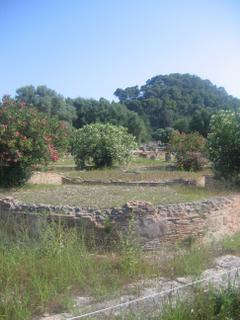
Casual observers often have difficulties warming up to building remains that have been leveled to the ground. However, the Leonidaion in the southwest section of the archaeological site at Olympia is an exception. A unique feature, the pool and garden structure at its centre, makes this ruin one of the more intriguing profane buildings of the site.

The Leonidaion takes its name from Leonidas of Naxos, who was both its architect and financial sponsor. The original building was constructed around 330 BC (in the time of Alexander the Great) on very regular plan (http://tinyurl.com/8wmrt). During the Hellenistic period, the Leonidaion was a luxury guest house.


The almost square building was surrounded by an outer colonnade in the Ionic style, which is clearly visible in the picture's foreground and extending away from the viewer. The wings, represented in the picture by low walls, were divided into regular units, with 6 larger ones being located in the west wing and 12 smaller ones in each of the other wings. The rooms opened onto a central courtyard surrounded by a Doric peristyle, whose column stumps are visible further away. The bushes toward the center left mark the former location of the courtyard. The large stone block in the front at the bottom left once supported a statue.

The building was entered from the north and south sides. The picture shows the narrow, brick-paved passage of the south entrance. It leads to the peristyle and courtyard from where the rooms were accessed.

In the Roman period, the internal divisions of the wings were rearranged on a more irregular plan (http://tinyurl.com/dtwsg). More importantly, the courtyard was replaced by a pool with a garden island in the shape of a four-leaf clover at its centre. This island surrounded another, circular pool-and-island structure. The flowering bushes, a modern reminder of a vanished Roman garden, stand on the outer island, with the inner island is clearly visible between them. This water and garden feature gives the Leonidaion its distinctive and eye-catching appearance that is particularly evident in aerial photographs (e.g., http://tinyurl.com/7jm6w, where the Leonidaion is in the left corner of the picture).

Pausanias, who wrote his Description of Greece around AD 174, refers to the Leonidaion in a few passages in his description of Olympia (V.xv.1-4 and VI.xii.1, the text is available in English at http://tinyurl.com/86trg, a Greek version can also be accessed from there). Unfortunately, he offers no description but only names Leonidas as the architect and states its contemporary use as the quarters of Roman officials. Otherwise, he merely uses it as a reference point for locating statues and other monuments he is more interested in.

Like many other buildings in Olympia, the Leonidaion was severely damaged and eventually destroyed by human action and earthquakes in the 3rd to 6th centuries AD. What remained was covered by river sediments until archaeologists arrived in the 19th cent.

All links in this post lead to pages of the Perseus project, which is hosted by Tufts University. Its copyright notice can be read at: http://www.perseus.tufts.edu/copyright.html. Three cheers to all who have helped to make this outstanding resource available on the net!

I took the pictures in this post on June 4 & 5, 2005 and retain copyright. Commercial/for profit use without explicit written permission is strictly prohibited. If you wish to use these pictures for non-profit/non-commercial use, please notify me and credit them properly.

Cardinal Flower


The cardinal flower (Lobelia cardinalis) is one of many beautiful flowers that grow in the Beaver Valley of Ontario. It has been one of my favourites since I first saw a cardinal flower years ago on a canoe trip along the Beaver River, where it grew out in the open on an old beaver den.

I found the plant in the pictures on Labour Day weekend while walking along Mill Creek towards Duncan. This one grew in a fairly shady spot similar to the one shown below. The location on a stream bank is typical.

Cardinal flowers grow in a large part of North America. I don't know if they form stands elsewhere but, at least around here, they seem to be sporadic and usually only one or at most a few plants can be found in any given spot.

There are several other lobelia species in North America. Most have blue flowers, and many allegedly have medicinal properties. The most potent medicinal species is Indian tobacco (Lobelia inflata) with a tradition of use that extends back to the pre-Columbian period. It is apparently still used as an herbal treatment for asthma and other respiratory problems. The cardinal flower's medicinal effects are described as being similar but much milder, so it isn't used much. The following sites (among many others) list uses and references for further reading. It is unlikely that it really works for all the listed afflictions: www.ibiblio.org/pfaf/cgi-bin/arr_html?Lobelia+cardinalis and http://botanical.com/botanical/mgmh/l/lobeli38.html. The cardinal flower is also potentially poisonous so it's best to check with a qualified medical practitioner before using it.

Since I am becoming more and more interested in growing water plants, I think I may try my hand at water lobelia (Lobelia dortmanna) somewhen in the future if I can find a garden center that carries them.

Thursday, September 15, 2005

Fossils in Building Material at Olympia, Greece


Many buildings at the ancient site of the Olympic games were built in a gray local stone that is packed with marine shell fossils. The Palaistra or wrestling school shown in the picture is a typical example. This stone is prone to weathering, so over time the shells are evident either as holes or as clearly profiled forms.

Where weathering has laid bare the shell casts, the scene is reminiscent of a shell-littered beach. Many shells were obviously fragmented before they were deposited and I saw no evidence of two cockle shells still being hinged together. It is likely that the shells were washed around for some time between the animal's death and the time of deposit. However, a fair number were fossilized in excellent condition.


These two pictures show the surface of building stone blocks. Cockles are by far the most common type of shell. They are easily recognized by the ribbing and half-heart shape. When both shells are hinged together, they look like a heart. Modern cockle species prefer mud or fine to medium sand into which they burrow. They are widely distributed around the globe in the intertidal zone and at varying depths of the subtidal zone. Cockles reproduce quickly because they are hermaphrodites, which is unusual for bivalves.

However, cockles are not the only type of shell found in building materials from Olympia. The following pictures show sections of the wall next to the door of the Byzantine church. Several gastropod shells are clearly visible.


The next picture shows a column section. Instead of exposing the shell casts, weathering has removed them from the stone matrix, giving the column a pock-marked appearance.


Olympia is located in a geological structure called the Pyrgos basin, which covers a large part of the NW Peloponnese. Its bedrock mostly consists of Plio-Pleistocene sediments with older Pliocene sediments cropping up over large sections-- not very old in geological terms (5 - 1.8 million years ago). The adjoining areas (and the entire central Peloponnese) are covered by older Mesozoic rocks.


I took the pictures in this page on June 4 & 5, 2005. No commercial/for profit use is permitted without my written permission. Please let me know if you plan to use these pictures for private or non-profit purposes and credit them properly.